For Christmas I got a copy of Suite Française by Irène Némirovsky. I was shopping with my mom (who is visiting from the Netherlands) just before Christmas, and while in Barnes & Noble this book caught my eye. She got it for me, and it was a good choice.
The book takes place in France during WWII. The title includes 'Suite' because the author intended for there to be five distinct parts, like a musical composition. She only survived long enough to complete two parts. She was a Russian Jew, and so she died in a concentration camp in 1942.
The first part of the book, called Storm in June is about the invasion of Paris by the Germans. This section flips back and forth between about five different groups of characters, each group having a different point of view on what is happening to them as French citizens. There is even one chapter that discusses the event from point of view of one family's cat. Overall Storm in June was interesting, but not as good as the second part.
The second part, called Dolce, is about the occupation of a French village by German troops. Some of the characters are the same as in Storm, but it mostly felt like I was reading a completely different book. This story was more deeply emotional, and I felt much more like I could relate to the characters. However, perhaps this was due to me, because when I visited France I felt more drawn to the country people than the city people. Regardless of this, the characters in this part of the book were more fleshed out and it seemed like the author spent more time with this part of the book. There also seemed to be more descriptive passages, whereas in the first part it felt like flashes of impressions. I think Némirovsky did this intentionally to give an impression of the invasion verses occupation. I personally more enjoyed getting to know the characters and reading about their reflections on the war, rather than about lots of impressions of the invasion and evacuation of Paris.
The end of the book includes two appendices and also the preface to the French addition. I was almost going to skip this part, but am really glad that I didn't because this was the best part of the book. The first appendix is the author's notes about her plans for the book. After reading the two stories I could really see a glimpse of her intentions, and they were indeed grand. It would have been magnificent. The second appendix is a series of letters that she and her family wrote during the war. They showed how the situation in France was changing for the Jews and 'Stateless' people. It was particularly sad to read her husbands letters in which he tried to find where she was after she had gone to the concentration camp. I highly recommend this book if you are interested in WWII history; it is a great combination of fiction and biography.
Showing posts with label Book Reviews. Show all posts
Showing posts with label Book Reviews. Show all posts
Friday, January 11, 2008

Saturday, July 28, 2007
The Lovely Bones
I read The Lovely Bones by Alice Sebold about a week ago. I noticed this book mentioned quite a bit lately, and my curiosity finally got the better of me. I wish it hadn't. The book is about a 14 year old girl who is raped and murdered by a neighbour. After she dies she watches her family, friends, and her murderer from heaven. The book is ultimately about the healing that takes place after this crime.
Certainly the subject is a difficult and important one, however, I am disappointed with how Sebold chose to present it. I feel like she chose some typical pop ways to make her book appeal to the public, and quite frankly I felt kind of tricked. I read a Salon article that states that this book is more literary fiction than a genre thriller. I have to agree that there are things about it that make it seem literary, such as Sebold's use of metaphor. In the beginning the the book, right after the crime takes place, Suzie (the main character) describes how, while floating over the earth, she is looking for clues in the cornfield (where the crime is committed) and would see the burrows of rabbits whom she loved, and "who sometimes, unwittingly, brought poison home to their dens. Then inside the earth and so far away from the man or woman who had laced a garden with toxic bait, an entire family of rabbits would curl into themselves and die." When I read this I was stunned. I stopped and read it again several times; I felt completely locked in, and from that point on I knew I would have to finish this book to have closure. That is the thing with this story; it is written in a way that makes you identify strongly with Suzie and her family. That kind of power in writing is a good thing.
However, it is not a good thing when turned into the stuff of a thriller film. The murderer turns out to be a serial killer, and his other crimes are also described in graphic detail. There is a scene where Suzie's sister is inside the killer's house, looking for clues and he comes home while she is still in the house. My heart was beating twice as fast as usual the whole time I read that part. Now, it is is not that I don't like heart racing excitement in a book, but this was cheap.
I know it is true that such crimes happen, but by graphically describing these crimes seems to me to be a way of appealing to people's baser selves, and quite truthfully, a great way to appeal to the public at large. I hope that Sebold goes on to write things that will show her literary talents, but that she leave the pop thriller style of writing in her past.
Certainly the subject is a difficult and important one, however, I am disappointed with how Sebold chose to present it. I feel like she chose some typical pop ways to make her book appeal to the public, and quite frankly I felt kind of tricked. I read a Salon article that states that this book is more literary fiction than a genre thriller. I have to agree that there are things about it that make it seem literary, such as Sebold's use of metaphor. In the beginning the the book, right after the crime takes place, Suzie (the main character) describes how, while floating over the earth, she is looking for clues in the cornfield (where the crime is committed) and would see the burrows of rabbits whom she loved, and "who sometimes, unwittingly, brought poison home to their dens. Then inside the earth and so far away from the man or woman who had laced a garden with toxic bait, an entire family of rabbits would curl into themselves and die." When I read this I was stunned. I stopped and read it again several times; I felt completely locked in, and from that point on I knew I would have to finish this book to have closure. That is the thing with this story; it is written in a way that makes you identify strongly with Suzie and her family. That kind of power in writing is a good thing.
However, it is not a good thing when turned into the stuff of a thriller film. The murderer turns out to be a serial killer, and his other crimes are also described in graphic detail. There is a scene where Suzie's sister is inside the killer's house, looking for clues and he comes home while she is still in the house. My heart was beating twice as fast as usual the whole time I read that part. Now, it is is not that I don't like heart racing excitement in a book, but this was cheap.
I know it is true that such crimes happen, but by graphically describing these crimes seems to me to be a way of appealing to people's baser selves, and quite truthfully, a great way to appeal to the public at large. I hope that Sebold goes on to write things that will show her literary talents, but that she leave the pop thriller style of writing in her past.
Sunday, April 22, 2007
The Power of Play
I just finished reading The Power of Play: How Spontaneous, Imaginative Activities Lead to Happier, Healthier Children by David Elkind.
It is about the psychology of play, and Elkind discusses how important old-fashioned play is to children's development. By old-fashioned, I mean the kind of play that is not related to screens (Computer, T.V., etc.) He outlines the developmental stages of children, and discusses what type of activities are beneficial to their development considering these stages. Next he discusses how children's play has changed, and the possible effects that this could have on their development. Finally he gives ideas for parents to provide positive play experiences for their children.
Far from being a stuffy academic, Elkind offers understandable, as well as practical, information about the developmental stages of children, and how these stages effect what they get out of the activities in which they engage. He discusses that the advertisements for most computer games, as well as DVD's marketed to babies and young children, exaggerate their possible usefulness because they are not based on any real evidence. Basically they just appeal to parents fears of not giving their children an academic advantage (no matter how foggy the claims seem.) He also discusses how babies don't understand two-dimensional images on a screen the same way an adult does. This really makes a lot of sense to me. When I was learning to identify birds, I looked at some bird I.D. books with real photos, and some with just drawings. The ones with the drawing were always better and easier to learn from, because they took the average characteristics of the birds of the species. Sometimes the photos were extremely difficult to even see what the book was trying to illustrate, and I already knew what a real live bird is like! A baby does not, which is Elkind's point exactly. We need to provide real, not simulated, experiences for our children in order for them to enjoy, and learn from the world. Adults can often forget that for a child, the real world is full of magic, no matter how mundane it may be to us.
Well, in order to not give the wrong impression, I should say that Elkind is not completely against screen time. He says that in moderation it is okay, however we need to make sure that kids also have the time to play spontaneously. This leads to another thing that Elkind opposes that is hugely popular today: organized sports. Once again, he says that the evidence of the benefit for young children just isn't there, and also, that for older children a sports team in moderation is okay. However, he definitively states that the more emphasis on play, and not competition, the better. And the best of all, according to Elkind, is when kids are involved in spontaneous sports that the kids in the neighbourhood initiate themselves (with no parental involvement.) I couldn't agree more.
I have such great memories of spontaneous play in my own childhood. I am so glad that I didn't have to deal with being on a competitive sports team ( I did do fun dance classes) and I got lots of free time in the neighbourhood and my favourite place of all, the backyard. I have relatively few memories of T.V. but lots, and lots of memories of games, and play-acted scenarios that I played with my sister, the neighbour kids, and very often just by myself. I think my spontaneous play as a child, combined with the non-school related reading that I did, attributed heavily to the fact that I am an artist now. Childhood play is so important, and so often people blow it off like it is irrelevant. Let them play, let them play; they will become better people for it.
It is about the psychology of play, and Elkind discusses how important old-fashioned play is to children's development. By old-fashioned, I mean the kind of play that is not related to screens (Computer, T.V., etc.) He outlines the developmental stages of children, and discusses what type of activities are beneficial to their development considering these stages. Next he discusses how children's play has changed, and the possible effects that this could have on their development. Finally he gives ideas for parents to provide positive play experiences for their children.
Far from being a stuffy academic, Elkind offers understandable, as well as practical, information about the developmental stages of children, and how these stages effect what they get out of the activities in which they engage. He discusses that the advertisements for most computer games, as well as DVD's marketed to babies and young children, exaggerate their possible usefulness because they are not based on any real evidence. Basically they just appeal to parents fears of not giving their children an academic advantage (no matter how foggy the claims seem.) He also discusses how babies don't understand two-dimensional images on a screen the same way an adult does. This really makes a lot of sense to me. When I was learning to identify birds, I looked at some bird I.D. books with real photos, and some with just drawings. The ones with the drawing were always better and easier to learn from, because they took the average characteristics of the birds of the species. Sometimes the photos were extremely difficult to even see what the book was trying to illustrate, and I already knew what a real live bird is like! A baby does not, which is Elkind's point exactly. We need to provide real, not simulated, experiences for our children in order for them to enjoy, and learn from the world. Adults can often forget that for a child, the real world is full of magic, no matter how mundane it may be to us.
Well, in order to not give the wrong impression, I should say that Elkind is not completely against screen time. He says that in moderation it is okay, however we need to make sure that kids also have the time to play spontaneously. This leads to another thing that Elkind opposes that is hugely popular today: organized sports. Once again, he says that the evidence of the benefit for young children just isn't there, and also, that for older children a sports team in moderation is okay. However, he definitively states that the more emphasis on play, and not competition, the better. And the best of all, according to Elkind, is when kids are involved in spontaneous sports that the kids in the neighbourhood initiate themselves (with no parental involvement.) I couldn't agree more.
I have such great memories of spontaneous play in my own childhood. I am so glad that I didn't have to deal with being on a competitive sports team ( I did do fun dance classes) and I got lots of free time in the neighbourhood and my favourite place of all, the backyard. I have relatively few memories of T.V. but lots, and lots of memories of games, and play-acted scenarios that I played with my sister, the neighbour kids, and very often just by myself. I think my spontaneous play as a child, combined with the non-school related reading that I did, attributed heavily to the fact that I am an artist now. Childhood play is so important, and so often people blow it off like it is irrelevant. Let them play, let them play; they will become better people for it.
Saturday, April 14, 2007
Antigone (comparison of translations)
I picked up Antigone at the library this last week. I ended up getting two versions; one copy translated by Robert Bagg, and the other translated by Richard Emil Braun. I chose to read them both because I thought it would be interesting to see how they differ in the translation. The Bagg version claims that the author tried to satisfy the desire to be accurate, as well as considering how the words would sound to the reader. The Braun version states that 'only translators who write poetry themselves can properly recreate these tragedies." Well, I finished reading Antigone this afternoon, and I found that reading both versions, side by side, was definitely a good decision. I think that I got a much fuller understanding of the play than if I had only read one. I enjoyed it so much that I really wish that I had studied Ancient Greek so I could read what Sophocles actually wrote himself.
Well, who knows what will happen in the future.
As far as the two versions go, I think I enjoyed the Bagg version a little bit more. In the beginning of the play I felt like the Braun version was more emotive, but somewhere around the middle, he started to lose me sometimes. I would go back to the Bagg version, and feel like I was understanding it better, and in reality I didn't think the poetry in the Braun version was better, except in the very beginning where Antigone is talking with her sister.
In the end, Antigone was so absorbing, I have decided to continue reading the Bagg version. The book that contains this translation of Antigone is The Oedipus Plays of Sophocles, and also includes Oedipus the King, Oedipus at Kolonos, as well as an interesting essay about Greek Theater.
Well, who knows what will happen in the future.
As far as the two versions go, I think I enjoyed the Bagg version a little bit more. In the beginning of the play I felt like the Braun version was more emotive, but somewhere around the middle, he started to lose me sometimes. I would go back to the Bagg version, and feel like I was understanding it better, and in reality I didn't think the poetry in the Braun version was better, except in the very beginning where Antigone is talking with her sister.
In the end, Antigone was so absorbing, I have decided to continue reading the Bagg version. The book that contains this translation of Antigone is The Oedipus Plays of Sophocles, and also includes Oedipus the King, Oedipus at Kolonos, as well as an interesting essay about Greek Theater.
Thursday, April 12, 2007
Cymbeline
I just finished reading Cymbeline by William Shakespeare. I am going to just give a brief review of it, but as the play is rather convoluted, I'm not sure how true that will be. I will note now that while reading this play I listened to the dramatized play on CD that was produced by Arkangel.
Cymbline takes place in Britain and Rome during the time of Caesar. It is about King Cymbeline and how his daughter, Princess Imogen, marries a commoner by the name of Posthumus Leonatus without the King's knowing. When the king finds out, he banishes Posthumus to Rome. The Queen feigns sympathy to Imogen, and promises to appeal to the King for her. The Queen, Imogen's evil stepmother, has personal motivations that involve getting rid of Imogen so her son Cloten can take the throne. Later in the story Posthumus comes to believe that Imogen has been untrue, and convinces his servant to murder her. After lots of confusion and misunderstanding, the whole thing is resolved and Posthumus and Imogen are reunited, and there is general harmony and good will toward all.
That is really only the overriding plot of the play; there are at least three subplots that at first examination seem incongruous. As I alluded to above, there are lots of evil things instigated by the Queen, but also there are Imogen's two older brothers who were kidnapped when they were very young by a Lord who was betrayed by the King, and not told that they were princes until the end of the story. They are later reunited with their family, and are fully reinstated as rightful heirs to the throne. And of course, there is a war between Rome and Britain.
Throughout the play there are many magical elements such as magic potions that make people seem as though they are dead, and an appearance by the god Jupiter (remember this takes place in Caesar's day.) My favorite scene is where the dead family of Posthumus appear as ghosts and sing of his fortune and fate. They beg the god Jupiter for his life, and afterward, when he wakes from this 'dream' he finds a 'book' that in prophetic language his tells him his fate (amazing poetry.) The appearance of the ghosts is entirely sung, and the poetry made me feel like I was seeing though the veils that separates us from the spirit realm.
It is very difficult to give a concise plot summery of the play (as one can probably discern from my writing) and I had a hard time finding any criticism about it. If you have never heard of this play before, that is really not surprising; this play has fallen hugely out of favor during the last century, but I would argue that this is in part because of it's complexities, and also that the tastes of modern audiences desire a more clear and concise plot. To the play's credit Alfred, Lord Tennyson said it was his favorite, and John Keats also admired it as one of his favorites. I encourage those who have read Shakespeare's more well known works, to try reading this play. It is much more complex than a simple overview writing about it such as this can really express. I also highly recommend listening to the play on CD while reading it. It is not possible to watch it on film, so much of the nuances that a dramatic cast can reveal are only possible through listening to it.
Cymbline takes place in Britain and Rome during the time of Caesar. It is about King Cymbeline and how his daughter, Princess Imogen, marries a commoner by the name of Posthumus Leonatus without the King's knowing. When the king finds out, he banishes Posthumus to Rome. The Queen feigns sympathy to Imogen, and promises to appeal to the King for her. The Queen, Imogen's evil stepmother, has personal motivations that involve getting rid of Imogen so her son Cloten can take the throne. Later in the story Posthumus comes to believe that Imogen has been untrue, and convinces his servant to murder her. After lots of confusion and misunderstanding, the whole thing is resolved and Posthumus and Imogen are reunited, and there is general harmony and good will toward all.
That is really only the overriding plot of the play; there are at least three subplots that at first examination seem incongruous. As I alluded to above, there are lots of evil things instigated by the Queen, but also there are Imogen's two older brothers who were kidnapped when they were very young by a Lord who was betrayed by the King, and not told that they were princes until the end of the story. They are later reunited with their family, and are fully reinstated as rightful heirs to the throne. And of course, there is a war between Rome and Britain.
Throughout the play there are many magical elements such as magic potions that make people seem as though they are dead, and an appearance by the god Jupiter (remember this takes place in Caesar's day.) My favorite scene is where the dead family of Posthumus appear as ghosts and sing of his fortune and fate. They beg the god Jupiter for his life, and afterward, when he wakes from this 'dream' he finds a 'book' that in prophetic language his tells him his fate (amazing poetry.) The appearance of the ghosts is entirely sung, and the poetry made me feel like I was seeing though the veils that separates us from the spirit realm.
It is very difficult to give a concise plot summery of the play (as one can probably discern from my writing) and I had a hard time finding any criticism about it. If you have never heard of this play before, that is really not surprising; this play has fallen hugely out of favor during the last century, but I would argue that this is in part because of it's complexities, and also that the tastes of modern audiences desire a more clear and concise plot. To the play's credit Alfred, Lord Tennyson said it was his favorite, and John Keats also admired it as one of his favorites. I encourage those who have read Shakespeare's more well known works, to try reading this play. It is much more complex than a simple overview writing about it such as this can really express. I also highly recommend listening to the play on CD while reading it. It is not possible to watch it on film, so much of the nuances that a dramatic cast can reveal are only possible through listening to it.
Monday, April 9, 2007
Sequencing
Last Friday at my La Leche League meeting, the conversation turned toward staying home with ones' children when they are young, and the current attitudes of American society concerning this. Sequencing by Arlene Rossen Cardozo was mentioned by the leader as an interesting book concerning this topic. I took it home and read it over the last weekend.
Written almost twenty years ago, it is interesting to think that much of what is discussed in this book about the issues concerning womens' combining of career and parenting is relevant today. In the first part of the book, Cardozo begins the book with a review of the feminist movement. She also discusses the Superwoman Myth (the women who has a full-time career, family, social life, etc, all while getting enough sleep,) and proposes that women are finding a new way to have it all, and that is through Sequencing their lives. Sequencing, a term coined by Cardozo, is when a woman has a full life (career in her definition, though I would not define it so narrowly) before having children, then takes some years off to stay home with her children, and finally reintegrates career into her life when her children are a bit older. The first part continues with how a woman comes to the decision that she will stay home with her children.
The second part of the book discusses the reality of staying home, from how women cope with a change in identity, to what these women who stay home actually do to make there lives rich. It ends with a chapter that discusses how women make the transition from staying home to reintegrating career back into their lives.
The third part of the book discusses how and when these women go back to work. Cardozo discusses how things like the ages of ones children and field affect the time and type of reintegration of career.
Overall this was a good overview of the subject of mothering and career, and how one can integrate the two in realistic ways. The book is full of interviews with women that give it a feeling a practicality. I would recommend this book to anyone who wonders not only if it is possible to raise children and have a career, but also how; it really can be done, just not all at once.
Written almost twenty years ago, it is interesting to think that much of what is discussed in this book about the issues concerning womens' combining of career and parenting is relevant today. In the first part of the book, Cardozo begins the book with a review of the feminist movement. She also discusses the Superwoman Myth (the women who has a full-time career, family, social life, etc, all while getting enough sleep,) and proposes that women are finding a new way to have it all, and that is through Sequencing their lives. Sequencing, a term coined by Cardozo, is when a woman has a full life (career in her definition, though I would not define it so narrowly) before having children, then takes some years off to stay home with her children, and finally reintegrates career into her life when her children are a bit older. The first part continues with how a woman comes to the decision that she will stay home with her children.
The second part of the book discusses the reality of staying home, from how women cope with a change in identity, to what these women who stay home actually do to make there lives rich. It ends with a chapter that discusses how women make the transition from staying home to reintegrating career back into their lives.
The third part of the book discusses how and when these women go back to work. Cardozo discusses how things like the ages of ones children and field affect the time and type of reintegration of career.
Overall this was a good overview of the subject of mothering and career, and how one can integrate the two in realistic ways. The book is full of interviews with women that give it a feeling a practicality. I would recommend this book to anyone who wonders not only if it is possible to raise children and have a career, but also how; it really can be done, just not all at once.
Sunday, April 1, 2007
Anne of Green Gables
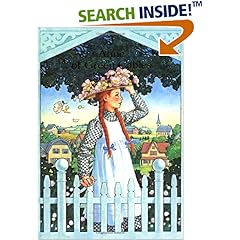
I just finished reading Anne of Green Gables. My first experience with this story was with the movie, and recently I listened to it on CD. I felt like listening to it was the same as reading it, and certainly it was close, but reading it was much richer. I love the wholesome characters of this story; it transported me to another world. Montgomory's descriptive passages are vivid and poetic. It was a great joy to read this in the early spring afternoons, while Joseph slept. So many of the delightful times in the book are during springtime.
I do have some criticism, though. I felt like chapter 33, The Hotel Concert, didn't really fit in with the story. It seemed an unnecessary digression, and was really kind of flat compared with all the other chapters. Also, I didn't understand how when only Gilbert and Anne are doing Second Year work at Queens (enabling them to get a First Class teaching license) that Ruby Gillis and Jane Andrews will also be teaching the following year. Perhaps it is because I don't understand the Canadian Schooling System, but I do find this confusing. If anyone understands this, I would be grateful to know.
I absolutely recommend reading this book if you haven't yet. As far as editions go, I highly recommend the Junior Illustrated Library edition, illustrated by Jody Lee. It is so beautiful, and the illustrations draw one quickly into the beautiful, fresh world of Avonlea.
Saturday, March 31, 2007
Almost French

I finished reading Almost French by Sarah Turnbull last Saturday. It is a memoir of her experience as an expat living in Paris. I tossed back and forth while reading this book, between liking it and not. In the beginning I was rather taken with it, as I love reading about Europe and Europeans, but after a while I got kind of annoyed with it. She didn't attempt to hide her ugly Australian in her account of her story, but I would hope that she was exaggerating for the goal of trying to be funny. As someone who is European, I didn't not find these things funny, and as an American, I found myself embarrassed, knowing too well that Americans are often guilty of the same offences. Well, all of that is personal for me, but concerning the writing, I felt that she dragged on a bit too long about not fitting in, and worst of all, how no one was going out of there way to make her feel accepted. It just came off as whiny, and I really couldn't help feeling like she should be the one trying to fit in, and not trying to change the people she was choosing to live among. Well, about a third of the way through, the character of her story changed, and she seemed like she was actually making an effort to fit in. Many of her descriptions of Paris life were fun, and made me long to go there again. She wrote a fun chapter on fashion, and how the french look at clothes. I think that was the best part for me. Overall, this was an average book for me. I don't think I would have finished it if it wasn't for the fact that we are reading it in my book club, however it ended up more fun toward the end and I am glad I got to read what she had to say about french fashion and food.
Wednesday, March 7, 2007
A Change of Heart
Right after I wrote that I wasn't enjoying Othello very much, I started enjoying it immensely. I often have to be careful of what I say aloud, because my outspoken opinions often get the best of me. Perhaps it is my nature of always defending the underdog.
Anyhow, I finished the play last weekend, and then started reading some critical literature about it. I read the synopsis of the story by Cinthio from his Hecatommithi, which is the primary source for Othello. While it is true that Shakespeare changed a lot of details (in most cases probably so it would work on stage,) the story is almost identical in plot. One of the differences is how Desdemona (Disdemona in Cinthio) dies. In the Hecatommithi, Iago and Othello beat her, and then arrange that part of the ceiling falls on her, so as to cover up the murder. Now, surely Shakespeare changed this because this would not work well on stage, but something I wondered while reading the play is why did Othello choose to smother her? He first talks of poison, and then Iago says that no, it should be done by smothering. Somehow, Othello thinks this is more just. I found this rather confusing until, in The Friendly Shakespeare by Norrie Epstein, I read that this serves symbolic purposes. The play that seems a bit unfocused in the first scene, telescopes into a suffocating, oppressive thing by the end.
There were lots of other things that bothered me in the beginning too, like why is Othello so gullible? But now I realize that this probably has to do with how the Moors were viewed in England at the time. It is also possible that it just serves the plot to characterize him has being naive. However I still am annoyed by the character Emelia. Why did she just give Iago Desdemona's handkerchief with barely a question? She is obviously a woman of the world, as is evidenced by act 4, scene 3. So why is she so dim when it concerns her husband? I think this is where Shakespeare's alteration of Cinthio's story is weak. Emelia is Shakespeare's character, not Cinthio's. In the original story Iago steals the handkerchief himself, by distracting Disdemona with his three year old daughter. Granted, having a young child wouldn't have worked in 17th century England, but couldn't he have written something more believable?
Overall, the strong points of Othello are the language, but I maintain that it doesn't hold a candle to Hamlet.
***Update. I am now not annoyed with Emelia, since I saw the movie. I simply love this play now; I have seen the light.
Anyhow, I finished the play last weekend, and then started reading some critical literature about it. I read the synopsis of the story by Cinthio from his Hecatommithi, which is the primary source for Othello. While it is true that Shakespeare changed a lot of details (in most cases probably so it would work on stage,) the story is almost identical in plot. One of the differences is how Desdemona (Disdemona in Cinthio) dies. In the Hecatommithi, Iago and Othello beat her, and then arrange that part of the ceiling falls on her, so as to cover up the murder. Now, surely Shakespeare changed this because this would not work well on stage, but something I wondered while reading the play is why did Othello choose to smother her? He first talks of poison, and then Iago says that no, it should be done by smothering. Somehow, Othello thinks this is more just. I found this rather confusing until, in The Friendly Shakespeare by Norrie Epstein, I read that this serves symbolic purposes. The play that seems a bit unfocused in the first scene, telescopes into a suffocating, oppressive thing by the end.
There were lots of other things that bothered me in the beginning too, like why is Othello so gullible? But now I realize that this probably has to do with how the Moors were viewed in England at the time. It is also possible that it just serves the plot to characterize him has being naive. However I still am annoyed by the character Emelia. Why did she just give Iago Desdemona's handkerchief with barely a question? She is obviously a woman of the world, as is evidenced by act 4, scene 3. So why is she so dim when it concerns her husband? I think this is where Shakespeare's alteration of Cinthio's story is weak. Emelia is Shakespeare's character, not Cinthio's. In the original story Iago steals the handkerchief himself, by distracting Disdemona with his three year old daughter. Granted, having a young child wouldn't have worked in 17th century England, but couldn't he have written something more believable?
Overall, the strong points of Othello are the language, but I maintain that it doesn't hold a candle to Hamlet.
***Update. I am now not annoyed with Emelia, since I saw the movie. I simply love this play now; I have seen the light.
Tuesday, February 27, 2007
Lightness
I added a lighter book to what I am reading right now- Riquet Pique et le Coin Ideal. It is a children's book about a Porcupine who is trying to find the perfect place to live. I got it from my french teacher at Humboldt. I started it then when in classes, but couldn't find the time to finish it, even though it was a lot of fun.
Othello is not quite as exciting to read for me as I had hoped-which means not as interesting as Hamlet. Hamlet is my favorite Shakespearean tragedy, so I guess it isn't really fare to compare. However, I had read that Shakespeare wrote Othello in the same time period, and actually just after Hamlet, so I guess I had my hopes up for something nearly as good. Iago, the main character in Othello, is just so completely evil, and that is pretty much all there is to his character. It makes for a story of one evil person plotting against the innocent, and so far there isn't much more to it for me. In Hamlet, the murderer of his father is his uncle, who happens to be in love with Hamlet's mother (and she with him.) So, in that play the hate is tied up with love, and that makes things infinitely more interesting. I will finish Othello, but I defiantly needed something light when the evil gets to be too much.
Othello is not quite as exciting to read for me as I had hoped-which means not as interesting as Hamlet. Hamlet is my favorite Shakespearean tragedy, so I guess it isn't really fare to compare. However, I had read that Shakespeare wrote Othello in the same time period, and actually just after Hamlet, so I guess I had my hopes up for something nearly as good. Iago, the main character in Othello, is just so completely evil, and that is pretty much all there is to his character. It makes for a story of one evil person plotting against the innocent, and so far there isn't much more to it for me. In Hamlet, the murderer of his father is his uncle, who happens to be in love with Hamlet's mother (and she with him.) So, in that play the hate is tied up with love, and that makes things infinitely more interesting. I will finish Othello, but I defiantly needed something light when the evil gets to be too much.
Wednesday, February 21, 2007
On to Othello
I finished reading March on Monday. What a great story! At times the flowery prose can be a bit difficult to completely follow, but this was really only concerning the main character's letters home. The author did this in order to accurately render the time of the story, which is during the civil war. Toward the end of the book, I was having a difficult time putting it down. Once while reading it, with Joseph sleeping on my lap, Jim came into the room to tell me something, and I looked at him with wide eyes and my heart was beating rapidly. I was right in the middle of a scene of an attack on some recently freed slaves and the main character is trying to help save them. Brooks' writing is so tangibly realistic; at one point in the story the main character was trying to escape the attackers. He is going into a woodpile in order to hide, and the author describes the scene with such realistic detail that she writes about how he feels a searing pain from a splinter in his thumb.
Subscribe to:
Posts (Atom)